GDP growth with Economic Stability: An FDI perspective
Asma Salman , Hui Xiao Feng
School of Management, Harbin Institute of Technology, Heilongjiang Province, China
asmaiqbal@yahoo.com a, xfhui@hit.edu.cn b
Abstract
In a capital-poor country like Pakistan, FDI can emerge as a significant vehicle to build up physical capital, create employment opportunities, develop productive capacity, enhance skills of local labor through transfer of technology and managerial know-how, and help integrate the domestic economy with the global economy. This paper provides an assessment of the current situation of FDI in Pakistan and examines its impact on the country’s balance of payments. As developing countries, remove restrictions and implement policies to attract FDI inflows, trade and investment have become increasingly intertwined. FDI inflows, however, needs significant institutional reforms, radically reduced levels of control, better provision of essential infrastructures, perceived improvement in investment climate, and sustained socio-political.
Introduction
Foreign Direct Investment (FDI) as a growth-enhancing component has received great attention of developed countries in general and less developed countries in particular in recent decades. It has been a matter of great concern for many economists that how FDI affects economic growth of the host country. In a closed economy, with no access to foreign saving, investment is financed solely from domestic savings. However, in open economy investment is financed both through domestic savings and foreign capital flows, including FDI. The investments in form of FDI enable investment-receiving (host) countries to achieve investment levels beyond their capacity to save.
Foreign direct investment (FDI) is a potent weapon of developing the Pakistan economy and can play an important role in achieving the country’s socio-economic objectives including poverty reduction goals. Over the last couple of decades FDI has remained the largest form of capital flow in the developing countries far surpassing portfolio equity investment, private loans, and official assistance. In 1997, FDI accounted for 45 percent of net foreign resource flows to developing countries, compared with 16 percent in 1986 [Perkins (2001)]. Moreover, the World Bank (2002) reported that in 1997 developing countries received 36 percent of total FDI flows. Most developing countries now consider FDI as an important source of development, but its economic effects are almost impossible to either predict or measure with precision. However, many empirical studies have shown significant role of FDI in economic growth of host developing countries, through its contribution in human resources development, technological transfer, capital formation and international trade.
Current Situation of FDI in Pakistan
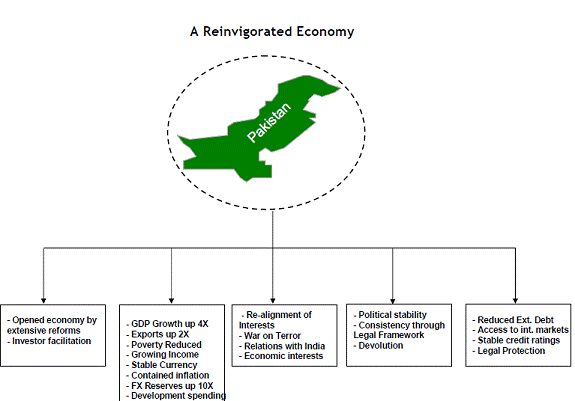
Pakistan has experienced GDP growth in the 6-8% range in 2004-07, spurred by gains in the industrial and service sectors. Poverty levels have decreased by 10% since 2001, and Islamabad has steadily raised development spending in recent years, including a 52% real increase in the budget allocation for development in financial year 2007. Since independence Pakistan has had to depend on foreign assistance in its development efforts and to balance its international debt payments. In 1960 the World Bank organized the Aid-to-Pakistan Consortium to facilitate coordination among the major providers of international assistance. The consortium held 92% of Pakistan's outstanding disbursed debt at the end of June 1991. The consortium's members include the United States, Canada, Japan, Britain, Germany, France, and international organizations such as the World Bank and the Asian Development Bank (ADB). The World Bank accounted for 26% of the outstanding debt, and the ADB, which was the largest lender in the early 1990s, accounted for 15%. Most non-consortium funding comes from Saudi Arabia and other oil-producing Middle Eastern countries. Most aid is in the form of loans, although the proportion of grants increased from around 12% in the late 1970s to around 25% in the 1980s, mainly because of food aid and other funds directed toward Afghan refugees. With the decline in this aid after 1988, the proportion of grants decreased to 16% in 1992. The United States has been a major provider of aid since independence and was the largest donor in the 1980s. The unsustainable economic growth has been blamed mainly on the high inflation rate, a mounting fiscal deficit, increasing foreign debt and debt servicing, weak foreign demand for Pakistani products, low level of physical and human capital, unfavorable weather, political instability, and, among other factors, a deteriorating law and order situation in the country. Pakistan is a rapidly developing country and a major emerging market with an economic growth rate of 7 % per annum for four consecutive years up to 2007. Despite being a very poor country in 1947, Pakistan's economic growth rate was better than the global average during the subsequent four decades, but imprudent policies led to a slowdown in the late 1990s. The 2005 estimate of foreign debt was close to US$40 billion. Pakistan's gross domestic product, as measured by purchasing power parity (PPP), is estimated to be US$ 475.4 billion while its per capita income (PCI) stands at $2,942. The poverty rate in Pakistan is estimated to be between 23% and 28%. Pakistan's GDP growth rates have seen a steady increase over the last 5 years. However, inflationary pressures and a low savings rate, among other economic factors, could make it difficult to sustain a high growth rate.
Since the last decade, there has been a considerable change in global flows of trade and finance including a surge in FDI. Despite being a recent phenomenon, several underlying factors have contributed to increasing the FDI inflow in Pakistan, such as trade and exchange liberalization, current account convertibility, emphasis on private sector led development, liberalization of the investment regime, opening up of infrastructure and services to the private sector-both domestic and foreign, and above all the interest of foreign investors in energy and telecommunication sector. It is argued that more open trade policies are associated with the presence of foreign firms and economy-wide technological and productivity gains in developing countries like Pakistan. There also exists evidence of a strong positive correlation between increasing share of FDI in GDP and diversification to high-technology exports in countries that have open trade regimes.
Still, FDI constitutes a low share in GDP or gross investment of the country.
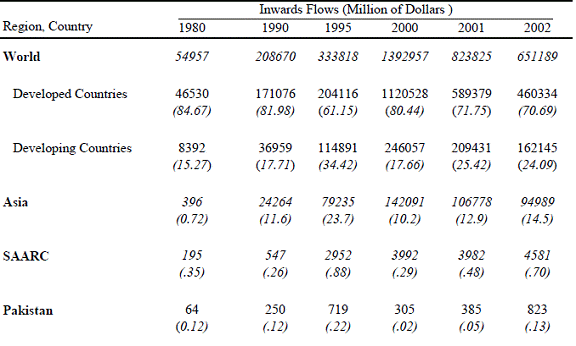
The volume of FDI inflows to Pakistan with comparison to other countries is given in Table 1. Also find the figure below to see the constant growth, and increase in GDP in Pakistan since 2000’s. Also a comparison to few countries is given below in Figure 1.
Fig 1: FDI as a % of GDP
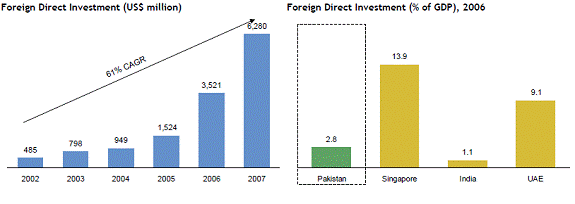
Table 1: Inward Flows
It may be mentioned that the surge in FDI in the energy and telecom sectors in Pakistan is associated with heavy import content and little impact on foreign exchange reserve accumulation. This also raises a long term concern relating to the country’s ability to generate sufficient foreign exchange to finance remittance of profits and income originating from foreign investment. An associated concern is the rapid accumulation of foreign debt obligations of various maturities by the private sector; the outstanding stock of private sector debt has now reached a significant level. The rapidly accumulating private sector debt gives rise to interest and principal payments in foreign exchange over and above official debt obligations to bilateral and multilateral agencies.
Sectoral and Country-wise distribution of FDI inflows
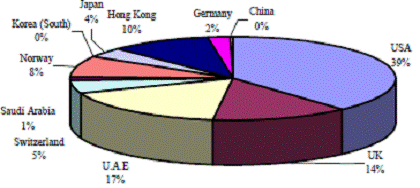
The sector-wise inflow and the country-wise inflow of FDI for FY08 are presented in Table 2 and 3. We can see the major inflows are from the developed world, namely, USA 39%, UK 14%, and Hong Kong 10%. Rest of the world consists of Saudi Arabia, Germany, Switzerland, Norway, Koreas, Japan and UAE.
Table 2: Country-wise FDI inflow Pie Chart
The overall foreign investment has two components i.e. foreign direct investment and portfolio investment (investment in equity market). The table below shows the total investment along with foreign direct investment and portfolio investment in the country during the past few years. Pakistan total investment in 2007-08 has decreased by 38.38% from 2006-07. The foreign investment in year 2007-08 is US$ 5,193 million where as FDI was US$ 5, 152.8 million and the portfolio investment was US$ 40.1 million. There are number of reasons of declining foreign investment which include; political instability, policy adhocism, poor law & order situation and lack of trained human resource.
Most of Pakistan’s investment comes from its War on Terror. During the year 2008, US have the largest share of 38.46% of FDI Inflow followed by UAE (17.23%), UK (13.52%), Hong Kong (9.98%) and Norway (8.08%).
Table 3: Sector-Wise FDI Inflow Pie Chart
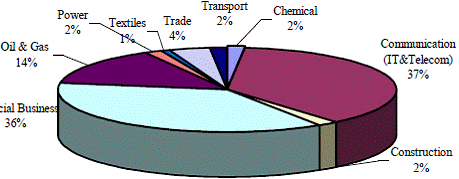
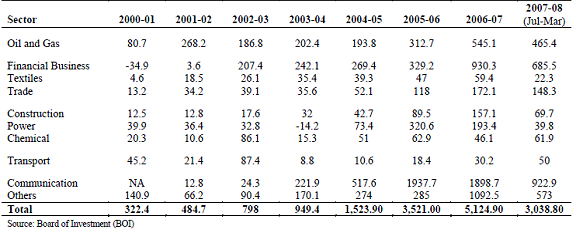
Table 4: Sector Wise FDI
There are three broad sectors of FDI inflows: infrastructure, manufacturing, and services.
Accordingly to sector wise analysis, the communication (IT & Telecom) sector bring highest foreign investment of 1, 625.3 million with 37% share in year 2007-08, financial business 1,607.6 million (36%), oil & gas 634.8 million (14%), power 70.3 million (6%) and trade with 175.5 million having 4% share in total FDI.
Over the 1998-2007 periods, gas and oil, textiles, and trade and commerce dominated the first half in terms of FDI inflow whereas telecommunication sector was the highest recipient during the second half of the ten year period. On the other hand, gas and oil, and trade and commerce sectors showed better performance during the last two years but the textiles sector experienced declining inflow of FDI in the second half of the decade.
Impact on Balance of Payments
The economic impact of FDI on the level of economic activity has been widely investigated in recent years across different countries. Some results suggest that the inflow of FDI can ‘crowd in’ or ‘crowd out’ domestic investment depending on specific circumstances. Overall, FDI has a positive impact on economic growth but the magnitude of the effect depends on the availability of complementary resources, especially on the domestic stock of human capital.
In Pakistan, FDI inflows are reported under the capital and financial account of the country’s Balance of Payments (BOP) statement which provides the direct effect on the BOP. Thus the inflow of FDI plays an important role in determining the surplus/deficit in the capital and financial account of the BOP statement. From the above, it can be said that the initial impact of an inflow of FDI on Pakistan’s BOP is positive but the medium term effect could become either positive or negative as the investors increase their imports of intermediate goods and services, and begin to repatriate profit.
FDI can also crowd out domestic investment by borrowing in domestic capital markets, thus driving up interest rates and cost of capital to business. High domestic interest rates may also be the result of deliberate government policies to attract foreign capital. The higher than global average interest rates will also cause the exchange rate to be overvalued, further crowding out domestic firms producing for export. While foreign firms will also suffer from loss of competitiveness, the impact is cushioned by their access to foreign sources of financing. While much is made of the potential for FDI to increase foreign exchange earnings, there is a risk that it will instead contribute to crises in the balance of payments by repatriating profits and by increasing the rate of imports faster than the rate of exports. Hence the biggest risk is that FDI could lead to an overall contraction, rather than an increase, in domestic investment and subsequently economic growth. Indeed, the possibility that FDI might lead to fundamental economic distortion and pervasive damage to the development prospects of the country is ever present.
What is interesting or rather fortunate to note is that currently Pakistan is bent more towards reaping the favorable side of the FDI inflows. Though increased foreign inflows in the recent months have expanded the reserve money growth, the benefits of these inflows cannot be ignored.
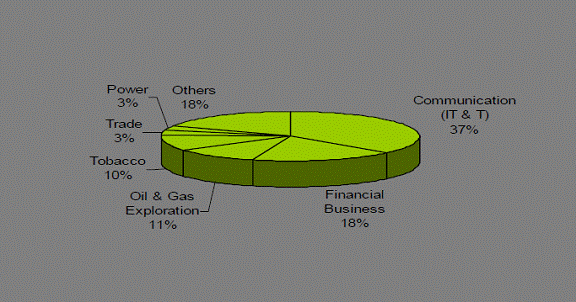
Figure 3 gives the classification of the FDI inflows in terms of different sectors of the economy for the first nine months of the current fiscal year. The communications sector and the financial business sector, being the major recipients of FDI inflows have contributed significantly towards the economy’s GDP. This is because investment in electronics and other high-tech industries is widely seen positively in developing countries like Pakistan, providing employment opportunities, and boosting exports by increasing production and in modernizing the economy. However the manufacturing sector, especially the textile sector, has received meager FDI inflows. This means that Pakistan has received little export oriented FDI, limiting the role of FDI as a tool of export promotion. Besides these sectors, in other sectors, many foreign companies including Nestle, Unilever and Procter & Gamble are expanding their infrastructure in the country.
Fig 2: FDI by Leading Sectors
Source: BOI, Pakistan
Taking the presence of Nestle in Pakistan as a case-in-point, the success of FDI in the economic well being of the country is all the more obvious. Nestle Pakistan Limited formerly known as Nestle Milkpak Limited came into limelight with its product, Milkpak. The Group’s principal activities involve manufacturing, processing and selling food products and ancillary equipment. The food products include diary, confectionery and culinary products, coffee and beverage and drinking water.
Table 5
The
above results show that FDI contributes positively to increasing
imports and exports and can either improve or deteriorate the country’s
trade balance depending on the relative magnitude of the two forces.
However, with a. positive effect of FDI inflows on the financial
account, it is more likely that the first round effect of FDI is
positive on the BOP of Pakistan.
Policy Implications
In the current situation of fragile balance of payment position and worsening economic indicators, Pakistan badly needs to boost industrial productions and achieve more stable economy. For that it needs to improve and mobilize its foreign resource to augment real infrastructure development in Pakistan to offer long-term stability in economic activities. Foreign investment today is like backbone of Pakistan’s economy and the Government seems on their toes to attract a few more privatization and acquisition deals from investors so as to survive in the recent future. World Bank has affirmed its supports of US$ 1 billion investment, which will help Pakistan to keep its economy afloat. There is dire need of huge foreign investment, which will help to mobilize the economic development activities and achieve stability and further attract new investments in the country.
For the purpose, several policy areas are important that include:
Our findings suggest that FDI plays an important role in contributing to economic growth. However, domestic financial sector development is crucial for positive effects to realise that has not been shown before. We also provide evidence that the link between FDI and growth is causal, where FDI promotes growth through financial sector development. Furthermore, the results suggest that better domestic financial conditions not only attract foreign companies but also allow host economy to maximise the benefits of foreign investments. Pakistan has a number of positive attributes that can successfully attract the attention of foreign investors from both developed and developing countries. The increasing availability of skilled and unskilled labor at relatively low wages and the success in maintaining reasonably stable macroeconomic environment are a few factors behind making the country an attractive destination for foreign investors. They are generally aware that the wage rates in Pakistan are among the lowest in Asian countries, the rate of inflation is usually contained within tolerable limits, the exchange rate is reasonably stable, custom regulations are investment friendly without discrimination between foreign and domestic investors, and attractive incentive packages are available for the foreign investors.
Pakistan needs to undertake effective promotion measures to convince the potential foreign investors that their involvement in business activities in the country is valued, they would be facing friendly regulations, and they can enjoy investment incentives that are competitive with those offered by other countries in the region and the developing world. The country also needs to move forward through implementing investment friendly policies, simplifying regulatory practices, and removing inefficient bureaucratic procedures.
Over the last decades, almost all developing Asian economies including Pakistan have progressively adopted more open policies toward FDI and this trend is likely to continue in the foreseeable future. The general conclusion of this study is that FDI brings net benefit to Pakistan. These benefits appear to be important for integrating the domestic economy with the global economy and in the area of technology and skill transfer.
REFERENCES:
Khan, A. J. and Y-H. Kim (1999), Foreign Direct Investment in Pakistan: Policy Issues and Operational Implications, EDRC Report No. 1999 (66), Asian Development bank
Shirouzu, H. (1993), Observations on General Economic Situation of Pakistan Relating to Investment Climate, The Federation of Pakistan Chambers of Commerce and Industry, Karachi.
WB (2007), World Development Indicators, World Bank
Zaidi, Hussain H. (2004) Snags in the Inflow of FDI. Dawn, the International Edition, 09 August. Also available from http://DAWN.com
Zang, Kevin Honglin (2001) How Does Foreign Investment Affect Economic Growth in China? Economics of Transition 9: 3, 679–693.
Gao, Ting (2004) FDI, Openness and Income. The Journal of International Trade and Economic Development. 13: 3, 305–323.
Quid Pro Quo http://www.mcb.com.pk/quick_links/economic_reports.asp
Yasmin, Bushra, Aamrah Hussain, and Muhammad Ali Chaudhary (2003) Analysis of Factors Affecting Foreign Direct Investment in Developing Countries. Pakistan Economic and Social Review 91: 1 & 2, 59–75.
Government of Pakistan. Ministry of Finance Economic. Economic situation. Review of Economic Situation during July-May/June 2006-2007.
Razmi, A (2005): The Effects of Export-Oriented, FDI-Friendly Policies on the Balance of Payments in a Developing Economy: A General Equilibrium Investigation, Working Paper, University of Massachusetts. Mass.
Report on Currency and Finance 2002-03 (2004): Reserve Bank of India Ruane, F. (2006): Foreign Direct Investment in Ireland: Policy Implications for Emerging Economies, IIIS Discussion Paper, Department of Economics, Trinity College, Dublin.
Saeed, N. (2001): An Economic Analysis of Foreign Direct Investment and Its Impact on
Trade and Growth in Pakistan, Ph.D. thesis (unpublished), Islamic University of
Bahawalpur, Pakistan.
School of Management, Harbin Institute of Technology, Heilongjiang Province, China
asmaiqbal@yahoo.com a, xfhui@hit.edu.cn b
Abstract
In a capital-poor country like Pakistan, FDI can emerge as a significant vehicle to build up physical capital, create employment opportunities, develop productive capacity, enhance skills of local labor through transfer of technology and managerial know-how, and help integrate the domestic economy with the global economy. This paper provides an assessment of the current situation of FDI in Pakistan and examines its impact on the country’s balance of payments. As developing countries, remove restrictions and implement policies to attract FDI inflows, trade and investment have become increasingly intertwined. FDI inflows, however, needs significant institutional reforms, radically reduced levels of control, better provision of essential infrastructures, perceived improvement in investment climate, and sustained socio-political.
Introduction
Foreign Direct Investment (FDI) as a growth-enhancing component has received great attention of developed countries in general and less developed countries in particular in recent decades. It has been a matter of great concern for many economists that how FDI affects economic growth of the host country. In a closed economy, with no access to foreign saving, investment is financed solely from domestic savings. However, in open economy investment is financed both through domestic savings and foreign capital flows, including FDI. The investments in form of FDI enable investment-receiving (host) countries to achieve investment levels beyond their capacity to save.
Foreign direct investment (FDI) is a potent weapon of developing the Pakistan economy and can play an important role in achieving the country’s socio-economic objectives including poverty reduction goals. Over the last couple of decades FDI has remained the largest form of capital flow in the developing countries far surpassing portfolio equity investment, private loans, and official assistance. In 1997, FDI accounted for 45 percent of net foreign resource flows to developing countries, compared with 16 percent in 1986 [Perkins (2001)]. Moreover, the World Bank (2002) reported that in 1997 developing countries received 36 percent of total FDI flows. Most developing countries now consider FDI as an important source of development, but its economic effects are almost impossible to either predict or measure with precision. However, many empirical studies have shown significant role of FDI in economic growth of host developing countries, through its contribution in human resources development, technological transfer, capital formation and international trade.
Current Situation of FDI in Pakistan
Pakistan has experienced GDP growth in the 6-8% range in 2004-07, spurred by gains in the industrial and service sectors. Poverty levels have decreased by 10% since 2001, and Islamabad has steadily raised development spending in recent years, including a 52% real increase in the budget allocation for development in financial year 2007. Since independence Pakistan has had to depend on foreign assistance in its development efforts and to balance its international debt payments. In 1960 the World Bank organized the Aid-to-Pakistan Consortium to facilitate coordination among the major providers of international assistance. The consortium held 92% of Pakistan's outstanding disbursed debt at the end of June 1991. The consortium's members include the United States, Canada, Japan, Britain, Germany, France, and international organizations such as the World Bank and the Asian Development Bank (ADB). The World Bank accounted for 26% of the outstanding debt, and the ADB, which was the largest lender in the early 1990s, accounted for 15%. Most non-consortium funding comes from Saudi Arabia and other oil-producing Middle Eastern countries. Most aid is in the form of loans, although the proportion of grants increased from around 12% in the late 1970s to around 25% in the 1980s, mainly because of food aid and other funds directed toward Afghan refugees. With the decline in this aid after 1988, the proportion of grants decreased to 16% in 1992. The United States has been a major provider of aid since independence and was the largest donor in the 1980s. The unsustainable economic growth has been blamed mainly on the high inflation rate, a mounting fiscal deficit, increasing foreign debt and debt servicing, weak foreign demand for Pakistani products, low level of physical and human capital, unfavorable weather, political instability, and, among other factors, a deteriorating law and order situation in the country. Pakistan is a rapidly developing country and a major emerging market with an economic growth rate of 7 % per annum for four consecutive years up to 2007. Despite being a very poor country in 1947, Pakistan's economic growth rate was better than the global average during the subsequent four decades, but imprudent policies led to a slowdown in the late 1990s. The 2005 estimate of foreign debt was close to US$40 billion. Pakistan's gross domestic product, as measured by purchasing power parity (PPP), is estimated to be US$ 475.4 billion while its per capita income (PCI) stands at $2,942. The poverty rate in Pakistan is estimated to be between 23% and 28%. Pakistan's GDP growth rates have seen a steady increase over the last 5 years. However, inflationary pressures and a low savings rate, among other economic factors, could make it difficult to sustain a high growth rate.
Since the last decade, there has been a considerable change in global flows of trade and finance including a surge in FDI. Despite being a recent phenomenon, several underlying factors have contributed to increasing the FDI inflow in Pakistan, such as trade and exchange liberalization, current account convertibility, emphasis on private sector led development, liberalization of the investment regime, opening up of infrastructure and services to the private sector-both domestic and foreign, and above all the interest of foreign investors in energy and telecommunication sector. It is argued that more open trade policies are associated with the presence of foreign firms and economy-wide technological and productivity gains in developing countries like Pakistan. There also exists evidence of a strong positive correlation between increasing share of FDI in GDP and diversification to high-technology exports in countries that have open trade regimes.
Still, FDI constitutes a low share in GDP or gross investment of the country.
The volume of FDI inflows to Pakistan with comparison to other countries is given in Table 1. Also find the figure below to see the constant growth, and increase in GDP in Pakistan since 2000’s. Also a comparison to few countries is given below in Figure 1.
Fig 1: FDI as a % of GDP
Table 1: Inward Flows
It may be mentioned that the surge in FDI in the energy and telecom sectors in Pakistan is associated with heavy import content and little impact on foreign exchange reserve accumulation. This also raises a long term concern relating to the country’s ability to generate sufficient foreign exchange to finance remittance of profits and income originating from foreign investment. An associated concern is the rapid accumulation of foreign debt obligations of various maturities by the private sector; the outstanding stock of private sector debt has now reached a significant level. The rapidly accumulating private sector debt gives rise to interest and principal payments in foreign exchange over and above official debt obligations to bilateral and multilateral agencies.
Sectoral and Country-wise distribution of FDI inflows
The sector-wise inflow and the country-wise inflow of FDI for FY08 are presented in Table 2 and 3. We can see the major inflows are from the developed world, namely, USA 39%, UK 14%, and Hong Kong 10%. Rest of the world consists of Saudi Arabia, Germany, Switzerland, Norway, Koreas, Japan and UAE.
Table 2: Country-wise FDI inflow Pie Chart
The overall foreign investment has two components i.e. foreign direct investment and portfolio investment (investment in equity market). The table below shows the total investment along with foreign direct investment and portfolio investment in the country during the past few years. Pakistan total investment in 2007-08 has decreased by 38.38% from 2006-07. The foreign investment in year 2007-08 is US$ 5,193 million where as FDI was US$ 5, 152.8 million and the portfolio investment was US$ 40.1 million. There are number of reasons of declining foreign investment which include; political instability, policy adhocism, poor law & order situation and lack of trained human resource.
Most of Pakistan’s investment comes from its War on Terror. During the year 2008, US have the largest share of 38.46% of FDI Inflow followed by UAE (17.23%), UK (13.52%), Hong Kong (9.98%) and Norway (8.08%).
Table 3: Sector-Wise FDI Inflow Pie Chart
Table 4: Sector Wise FDI
There are three broad sectors of FDI inflows: infrastructure, manufacturing, and services.
Accordingly to sector wise analysis, the communication (IT & Telecom) sector bring highest foreign investment of 1, 625.3 million with 37% share in year 2007-08, financial business 1,607.6 million (36%), oil & gas 634.8 million (14%), power 70.3 million (6%) and trade with 175.5 million having 4% share in total FDI.
Over the 1998-2007 periods, gas and oil, textiles, and trade and commerce dominated the first half in terms of FDI inflow whereas telecommunication sector was the highest recipient during the second half of the ten year period. On the other hand, gas and oil, and trade and commerce sectors showed better performance during the last two years but the textiles sector experienced declining inflow of FDI in the second half of the decade.
Impact on Balance of Payments
The economic impact of FDI on the level of economic activity has been widely investigated in recent years across different countries. Some results suggest that the inflow of FDI can ‘crowd in’ or ‘crowd out’ domestic investment depending on specific circumstances. Overall, FDI has a positive impact on economic growth but the magnitude of the effect depends on the availability of complementary resources, especially on the domestic stock of human capital.
In Pakistan, FDI inflows are reported under the capital and financial account of the country’s Balance of Payments (BOP) statement which provides the direct effect on the BOP. Thus the inflow of FDI plays an important role in determining the surplus/deficit in the capital and financial account of the BOP statement. From the above, it can be said that the initial impact of an inflow of FDI on Pakistan’s BOP is positive but the medium term effect could become either positive or negative as the investors increase their imports of intermediate goods and services, and begin to repatriate profit.
FDI can also crowd out domestic investment by borrowing in domestic capital markets, thus driving up interest rates and cost of capital to business. High domestic interest rates may also be the result of deliberate government policies to attract foreign capital. The higher than global average interest rates will also cause the exchange rate to be overvalued, further crowding out domestic firms producing for export. While foreign firms will also suffer from loss of competitiveness, the impact is cushioned by their access to foreign sources of financing. While much is made of the potential for FDI to increase foreign exchange earnings, there is a risk that it will instead contribute to crises in the balance of payments by repatriating profits and by increasing the rate of imports faster than the rate of exports. Hence the biggest risk is that FDI could lead to an overall contraction, rather than an increase, in domestic investment and subsequently economic growth. Indeed, the possibility that FDI might lead to fundamental economic distortion and pervasive damage to the development prospects of the country is ever present.
What is interesting or rather fortunate to note is that currently Pakistan is bent more towards reaping the favorable side of the FDI inflows. Though increased foreign inflows in the recent months have expanded the reserve money growth, the benefits of these inflows cannot be ignored.
Figure 3 gives the classification of the FDI inflows in terms of different sectors of the economy for the first nine months of the current fiscal year. The communications sector and the financial business sector, being the major recipients of FDI inflows have contributed significantly towards the economy’s GDP. This is because investment in electronics and other high-tech industries is widely seen positively in developing countries like Pakistan, providing employment opportunities, and boosting exports by increasing production and in modernizing the economy. However the manufacturing sector, especially the textile sector, has received meager FDI inflows. This means that Pakistan has received little export oriented FDI, limiting the role of FDI as a tool of export promotion. Besides these sectors, in other sectors, many foreign companies including Nestle, Unilever and Procter & Gamble are expanding their infrastructure in the country.
Fig 2: FDI by Leading Sectors
Source: BOI, Pakistan
Taking the presence of Nestle in Pakistan as a case-in-point, the success of FDI in the economic well being of the country is all the more obvious. Nestle Pakistan Limited formerly known as Nestle Milkpak Limited came into limelight with its product, Milkpak. The Group’s principal activities involve manufacturing, processing and selling food products and ancillary equipment. The food products include diary, confectionery and culinary products, coffee and beverage and drinking water.
Table 5
| Dependent Variable: FDI | ||||
| Method: Least Squares | ||||
| Sample: 1975 2006 | ||||
| Included observations: 32 | ||||
| Variable | Coefficient | Std. Error | t-Statistic | Prob. |
| GDP | 0.009247 | 0.002212 | 4.179816 | 0.0002 |
| C | 633.7228 | 123.6778 | 5.123983 | 0.0000 |
| R-squared | 0.368033 | Mean dependent var | 1080.169 | |
| Adjusted R-squared | 0.346968 | S.D. dependent var | 436.4767 | |
| S.E. of regression | 352.7186 | Akaike info criterion | 14.62968 | |
| Sum squared resid | 3732312. | Schwarz criterion | 14.72129 | |
| Log likelihood | -232.0749 | Hannan-Quinn criter. | 14.66005 | |
| F-statistic | 17.47086 | Durbin-Watson stat | 1.586520 | |
| Prob(F-statistic) | 0.000232 | |||
Policy Implications
In the current situation of fragile balance of payment position and worsening economic indicators, Pakistan badly needs to boost industrial productions and achieve more stable economy. For that it needs to improve and mobilize its foreign resource to augment real infrastructure development in Pakistan to offer long-term stability in economic activities. Foreign investment today is like backbone of Pakistan’s economy and the Government seems on their toes to attract a few more privatization and acquisition deals from investors so as to survive in the recent future. World Bank has affirmed its supports of US$ 1 billion investment, which will help Pakistan to keep its economy afloat. There is dire need of huge foreign investment, which will help to mobilize the economic development activities and achieve stability and further attract new investments in the country.
For the purpose, several policy areas are important that include:
- Political Stability
- Quality of bureaucracy and governance
- law and order situation
- Development of infrastructure and human resources
- Improvement of port services
- Privatization and further reforms
- Modernization of business law
- Improving the country’s image abroad
- Policies regarding macroeconomic stability
- Economic and commercial diplomacy
- Confidence building measures
- Infrastructure
- Transfer of technology
Our findings suggest that FDI plays an important role in contributing to economic growth. However, domestic financial sector development is crucial for positive effects to realise that has not been shown before. We also provide evidence that the link between FDI and growth is causal, where FDI promotes growth through financial sector development. Furthermore, the results suggest that better domestic financial conditions not only attract foreign companies but also allow host economy to maximise the benefits of foreign investments. Pakistan has a number of positive attributes that can successfully attract the attention of foreign investors from both developed and developing countries. The increasing availability of skilled and unskilled labor at relatively low wages and the success in maintaining reasonably stable macroeconomic environment are a few factors behind making the country an attractive destination for foreign investors. They are generally aware that the wage rates in Pakistan are among the lowest in Asian countries, the rate of inflation is usually contained within tolerable limits, the exchange rate is reasonably stable, custom regulations are investment friendly without discrimination between foreign and domestic investors, and attractive incentive packages are available for the foreign investors.
Pakistan needs to undertake effective promotion measures to convince the potential foreign investors that their involvement in business activities in the country is valued, they would be facing friendly regulations, and they can enjoy investment incentives that are competitive with those offered by other countries in the region and the developing world. The country also needs to move forward through implementing investment friendly policies, simplifying regulatory practices, and removing inefficient bureaucratic procedures.
Over the last decades, almost all developing Asian economies including Pakistan have progressively adopted more open policies toward FDI and this trend is likely to continue in the foreseeable future. The general conclusion of this study is that FDI brings net benefit to Pakistan. These benefits appear to be important for integrating the domestic economy with the global economy and in the area of technology and skill transfer.
REFERENCES:
Khan, A. J. and Y-H. Kim (1999), Foreign Direct Investment in Pakistan: Policy Issues and Operational Implications, EDRC Report No. 1999 (66), Asian Development bank
Shirouzu, H. (1993), Observations on General Economic Situation of Pakistan Relating to Investment Climate, The Federation of Pakistan Chambers of Commerce and Industry, Karachi.
WB (2007), World Development Indicators, World Bank
Zaidi, Hussain H. (2004) Snags in the Inflow of FDI. Dawn, the International Edition, 09 August. Also available from http://DAWN.com
Zang, Kevin Honglin (2001) How Does Foreign Investment Affect Economic Growth in China? Economics of Transition 9: 3, 679–693.
Gao, Ting (2004) FDI, Openness and Income. The Journal of International Trade and Economic Development. 13: 3, 305–323.
Quid Pro Quo http://www.mcb.com.pk/quick_links/economic_reports.asp
Yasmin, Bushra, Aamrah Hussain, and Muhammad Ali Chaudhary (2003) Analysis of Factors Affecting Foreign Direct Investment in Developing Countries. Pakistan Economic and Social Review 91: 1 & 2, 59–75.
Government of Pakistan. Ministry of Finance Economic. Economic situation. Review of Economic Situation during July-May/June 2006-2007.
Razmi, A (2005): The Effects of Export-Oriented, FDI-Friendly Policies on the Balance of Payments in a Developing Economy: A General Equilibrium Investigation, Working Paper, University of Massachusetts. Mass.
Report on Currency and Finance 2002-03 (2004): Reserve Bank of India Ruane, F. (2006): Foreign Direct Investment in Ireland: Policy Implications for Emerging Economies, IIIS Discussion Paper, Department of Economics, Trinity College, Dublin.
Saeed, N. (2001): An Economic Analysis of Foreign Direct Investment and Its Impact on
Trade and Growth in Pakistan, Ph.D. thesis (unpublished), Islamic University of
Bahawalpur, Pakistan.


 Posts
Posts


0 comments:
Post a Comment